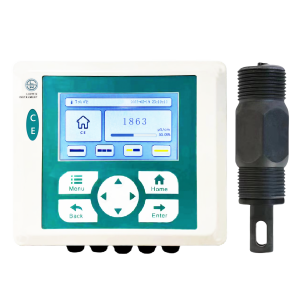
CE-D5
Conductivity analyzer
Digital quantity electrode ±3.0%FS
- APPLICATION
- Widely used in power plants petrochemicals metallurgy paper industry
- environmental water treatment light industry electronics and other fields. Monitoring and control of raw and produced water quality in water production equipment such as electricity plant cooling wate make-up water saturated water condensate and furnace water ion exchang reverse osmosis EDL seawater distillation etc.
- FUNCTIONAL CHARACTERISTICS
- Industrial online conductivity meter (hereinafter referred to as the instrument) is a water quality online monitoring instrument with a microprocessor. This instrument is equipped with conductivity electrodes of different types and constants for continuous monitoring and control of the conductivity and temperature values of aqueous solutions.
- The instrument adopts an LCD display screen; Intelligent Chinese menu operation; Equipped with 2 current outputsfreely adjustable measurement range high and low limit alarm prompts two sets of relay control switche adjustable hysteresis range
- automatic cleaning switch settings: automatic or manual temperature compensation: multiple automatic calibration methods for electrodes.
- According to user needs electrodes can be installed in various forms such as flow type
- sinking type pipeline type and flange type.
DESCRIBE
Structural features: The entire measurement system mainly consists of two parts: an instrument (secondary meter) and a conductivity electrode (primary meter). The electrode contacts the measured solution, and the instrument displays the conductivity value, temperature, and working status of the measured aqueous solution. Working principle: Measurement principle: In order to avoid electrode polarization, the instrument generates a highly stable sine wave signal applied to the electrode. The current flowing through the electrode is proportional to the conductivity of the measured solution. The instrument converts the current from a high impedance operational amplifier to a voltage signal, which is amplified, phase sensitive detected, and filtered by a programmable signal to obtain a potential signal reflecting the conductivity; The microprocessor alternately samples the temperature signal and conductivity signal through switch switching, and after calculation and temperature compensation, obtains the conductivity value and temperature value of the measured solution at 25℃. Temperature compensation principle: The conductivity of electrolyte solution is affected by temperature changes and requires temperature compensation. The temperature coefficient of a weak aqueous solution is 2.00%℃, and the higher the concentration, the smaller the temperature coefficient. The temperature coefficient for solutions with lower concentrations (1㎲·cm-1) is not set at 2.00%℃, but is set by the user, with a range of 0.00~9.99%.