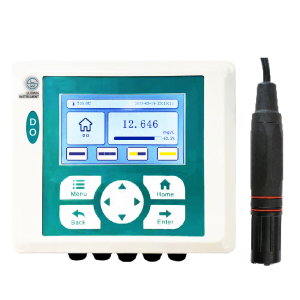
DO-C2
Digital quantity electrode
Membrane method 0~20.00mg/L±0.2mg/FS
- APPLICATION
- Suitable for mining industry applications
- as well as water and sewage treatment. It is reliably monitored:
- Flotation process
- Washing and immersion process
- Neutralization process
- Intake and outlet
- FUNCTIONAL CHARACTERISTICS
- Industrial dissolved oxygen instrument (hereinafter referred to as the instrument) is a water quality online monitoring instrument with a microprocessor. Widely used in industrial water
- domestic water and sewage treatment
- and aquaculture. The oxygen content in the aqueous solution was continuously monitored and controlled.
- The instrument adopts LCD LCD; intelligent Chinese menu operation; with current or voltage output
- free setting of measurement range
- high and low overlimit alarm warning and two sets of relay control switches and lag range adjustable; automatic or manual temperature compensation
- and automatic electrode calibration.
DESCRIBE
1.Structural characteristics: The whole measurement system is mainly composed of two parts: instrument (secondary table) and dissolved oxygen electrode (primary table). The dissolved oxygen electrode contacts the measured solution, and the instrument shows the oxygen content, temperature and working state of the aqueous solution.
2.Working principle: the oxygen electrode is made of platinum (Pt) cathode, Ag / AgCl as the anode, the electrolyte is 0.1M potassium chloride (KCl), and the silicone rubber permeable membrane is used as the breathable membrane. When measuring, a polarization voltage of 0.68V is added between the anode and cathode, oxygen is consumed at the cathode through the permeable membrane, and the amount of oxygen through the membrane is proportional to the concentration of dissolved oxygen in the water, so the limiting diffusion current between the electrodes is proportional to the concentration of dissolved oxygen in the water. The meter detects this current and transforms the oxygen concentration by calculation. Meanwhile, the thermistor detects the temperature of the solution and temperature compensates for the oxygen concentration.